Guess the Bird
Five times into a photograph of a bird is usually one patch of feathers — a few dozen barbs, a colour, and whatever pattern the colour is arranged into. The ladder is gentler than the animal game's because plumage is finer-grained than fur, and a deeper crop would be barbs and nothing else.
84 birds, from every continent including Antarctica. For a good third of them the identifying feature is the bill, which means the whole round is a wait for the frame to reach the front of the head.
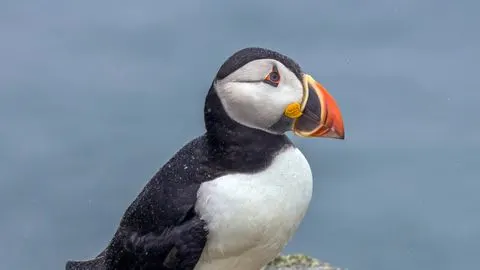
Name the bird from a patch of feathers.
Play Guess the BirdBarring, streaking and structural colour
Marks that run across the feather are barring; marks that run along it are streaking. Barring is common in owls, hawks and game birds; streaking belongs to a lot of small brown passerines. A single bold band across an otherwise plain feather field is often a wing bar, which places you on the folded wing rather than the breast.
Iridescence is the most useful signal in the game and the easiest to spot. Pigment colour is flat and consistent; structural colour shifts hue across the same feather and produces an oily sheen — the neck of a common starling, the head of a mallard, the whole body of a hummingbird. If a crop changes hue as it curves, you are looking at structural colour, and that eliminates most of the deck.
Black and white in hard-edged blocks with no intermediate tone is a seabird tell: penguins, puffins, gannets, auks. Four penguin species and two puffins are in the pool, and telling them apart is a matter of where exactly the white stops.
When the bill arrives
The last two rungs are where a beak or an eye usually enters the frame, and for the birds that are mostly beak — toucan, shoebill, hornbill, sword-billed hummingbird, spoonbill — that is effectively the answer arriving. Recognising that a round is one of those early is useful: if the first two rungs are an unremarkable field of one colour, the interesting part of the bird is somewhere else in the picture and you are better off buying rungs quickly than staring.
Bare skin is another shortcut. A patch of unfeathered colour — a wattle, a facial patch, a bill base — is bright, smooth and unlike anything else on a bird, and only a few dozen species have one worth photographing.
The ladder and the source
5x, 3.4x, 2.4x, 1.7x, 1.2x. The reveal caption gives the bird's name and where it lives, which is the part worth reading if you are playing this to learn rather than to score: the deck spans 61 different range descriptions, from the Arctic to sub-Antarctic islands to whichever city you happen to be in.
Photographs come from Wikipedia species articles, which lead with one clean picture of the bird. Family and genus pages were avoided because they tend to lead with a range map or a plate of nineteenth-century engravings.
Scoring
Ten rounds, five rungs, 1000 down to 150. Wrong guesses cost a rung, and with 84 similar-sounding names in the search box that matters — plenty of pairs in this deck differ by one word, and guessing the wrong puffin is as expensive as guessing a duck.