Guess the Insect
This ladder starts gentler than the other zoom games, at 4x rather than 7x or 8x, and there is a reason. These are macro photographs to begin with — a specimen already filling the frame — so magnifying one four times lands you on a single eye or one segment of a leg. Anything deeper is abstract art.
65 species, and the word insect is doing some work: eight spiders and three scorpions are in there too, which is the single most common way a round is lost.
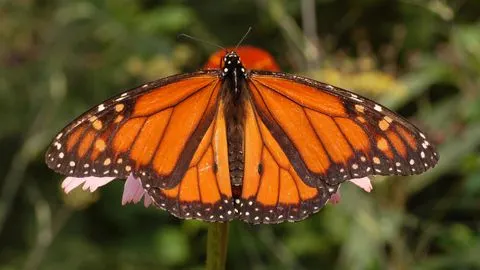
Name the insect from a close crop of it.
Play Guess the InsectCount what you can see
Legs are the first check and they are visible at surprising magnification. Six legs and a body in three parts is an insect; eight legs, no antennae and a body in two parts is an arachnid. If you can see a leg joint at all, count what is attached to it before you name anything.
Eyes are the second check. Compound eyes are a dome of hexagonal facets and belong to insects; the facet size itself is informative, because a dragonfly's are tiny and enormous in number. Jumping spiders have a pair of huge forward-facing simple eyes, which at this magnification is unmistakable and is one of the easier rounds in the deck.
Then the wings, if any are in frame. Hard, shining wing cases meeting in a straight line down the back are elytra, which means beetle — ten of the 65 are beetles. Scales that shed colour like dust mean butterfly or moth. Clear, veined, membranous wings mean fly, bee, wasp or dragonfly, and the vein pattern is genuinely diagnostic if you know it.
Moth or butterfly, bee or hoverfly
The two questions this deck asks most often have reliable answers. Moths tend to have feathered or comb-like antennae and a furry thorax; butterflies have clubbed antennae and a smoother body. The pool holds eight butterflies and four moths, and the Atlas moth and Luna moth are large enough that a crop of wing edge alone gives away the scale.
Bee versus hoverfly is a wing count and an eye check — the marmalade hoverfly in the deck is a fly wearing a wasp's colours, which is the entire point of it. Wasps have a hard, shiny, hairless body; bees are furry. At 4x that difference is the most obvious thing in the frame.
The ladder and the deck
4x, 2.9x, 2.1x, 1.6x, 1.15x — the shallowest final rung of any of the zoom games, because a macro photograph at 1.15x is still a close-up.
The 65 species break down as ten beetles, eight butterflies, eight spiders, four moths, four true bugs, four flies, three bees, three wasps, three scorpions and a long tail of ants, mantises, stick insects, grasshoppers and lacewings. Species articles were used wherever possible; family pages were only kept where the lead image is still one clear specimen rather than a plate of a dozen.
Scoring
Ten rounds at 1000, 620, 380, 240 and 150, with up to 160 for speed and a streak multiplier rising to 2×. This is a good game to play slowly: the speed bonus is worth less than a rung, and one careful look at leg count beats three fast guesses.