Guess the City
Six times into a photograph of a city is a few windows, a bit of roof, and whatever the light is doing that day. The ladder is deliberately shallower than the object or landmark games because city photographs are usually montages, and a deeper crop lands inside a single pane of glass and tells you nothing at all.
61 cities, weighted hard away from Europe and the United States. A deck that is half European capitals is a deck about spires, and this one is mostly Asia, Africa, the Gulf and Latin America — Ulaanbaatar, Accra, Dar es Salaam, Almaty, Caracas, Karachi.
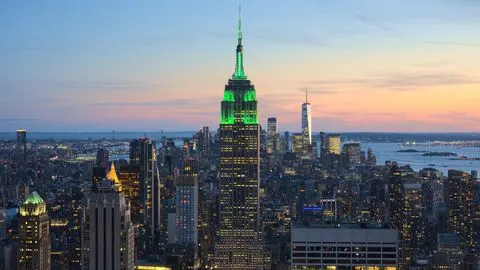
Name the city from a piece of its skyline.
Play Guess the CityWhat a facade tells you
Air conditioning units hanging on the outside of a building are one of the strongest signals available. Where you see them in dense grids across residential blocks you are in South or South East Asia, the Middle East or parts of Latin America; you will almost never see them on a Japanese, Korean or Gulf tower of the same vintage. Rooftop water tanks — black plastic in Brazil, stainless steel in India, dark cylinders in Mexico City — are similarly regional.
Glass tint dates a building. Bronze and heavily mirrored glazing is 1970s and 1980s; the very flat blue-green of low-iron glass is post-2000. A Gulf skyline is mostly the latter, because most of it was built after 2000.
Balconies are the other giveaway. Continuous balconies wrapped around every floor mean a warm climate and residential use; none at all means an office district. A wall of small individual balconies with laundry on them narrows the world down considerably.
Look past the towers
Most of these cities are more identifiable by what is behind them than by what is in front. Mountains rising straight out of the urban edge belong to a short list: Santiago, Cape Town, Kathmandu, Tehran, Almaty. A single flat-topped mountain is Cape Town and nothing else.
Water is the other frame. A harbour full of ferries, a river bending through the middle, a lagoon, a beach line running into towers — the geometry of the waterfront separates Hong Kong from Singapore from Rio faster than any building does.
Haze is worth reading rather than cursing. A pale, low-contrast, warm-grey atmosphere is characteristic of the big South Asian and Chinese cities in the deck and effectively rules out the Gulf, where the haze is dust-coloured and the light is harder.
The ladder and the source
6x, 4x, 2.8x, 1.8x, 1.2x. City articles on Wikipedia normally lead with a skyline shot or a montage of one, which is what the zoom crops into — though a few lead with the city's single best-known building instead, so a round can turn on a roofline rather than a river bend.
Two entries do not point at the city's own article. Singapore and Hong Kong are territories as well as cities, and those articles lead with a flag, so the city-centre article is used instead. The answer is still the city.
Scoring
Ten rounds at 1000, 620, 380, 240 and 150. The reveal gives the city and the country, and playing this deck through twice is a reasonable way to discover how much of the world's urban population lives in places you could not have named.