Guess the Car
A car photograph under nineteen pixels of blur, sharpening to eleven, then five, then two. Blur rather than zoom, because a car is identified by its silhouette and blurring is the one treatment that takes away the badge and the panel gaps while leaving the shape intact.
78 cars, from a 1906 Rolls-Royce Silver Ghost and a Ford Model T to the Tesla Model S and the Nissan Leaf. Most of them are recognisable from across a car park, which is the standard the list was built to.
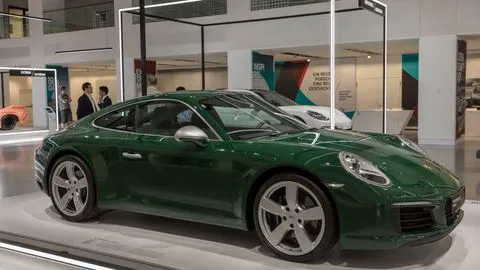
Name the car from its blurred silhouette.
Play Guess the CarRead the glasshouse
The greenhouse — the glazed area above the waistline — is the most distinctive part of a car and the part that survives blur best. Its length, where it starts and stops, and the angle of the pillars at each end will separate almost any two cars in this deck. A long bonnet, a short deck and a cabin pushed right back is a 1960s grand tourer. A cab-forward shape with the windscreen base ahead of the front axle centre is a modern hatchback or a van.
Then the stance. Ride height, the gap between tyre and arch, and wheel diameter relative to body depth date a car within about fifteen years on their own. Pre-war cars sit high on tall thin wheels; 1970s cars sit low with a deep body and small glass; anything after 2005 has wheels that look a size too big.
Roofline is the tiebreaker. A fastback that runs unbroken from the roof to the tail is a small family. A two-box shape with a vertical tailgate is a hatchback. A hard notch behind the rear window is a saloon, which in this deck is mostly the American section.
The photograph is dating itself
Blur does not hide the era of the picture. Colour film from the 1970s has a warm cast and blooming highlights; modern press photography is neutral and evenly lit. If the car is photographed on grass at what is obviously a classic show, it is old; if it is on a studio sweep, it is a press shot and therefore probably post-1990.
Headlights blur into bright blobs, which is more useful than it sounds — count them and read their shape. Four round lamps across the nose is an American car of the late 1950s or 1960s. A pair of pop-up lamps means a flat nose with no lamps visible at all, which is its own strong signal and covers a specific slice of 1980s and 1990s sports cars.
The ladder
19, 11, 5 and 2 pixels of blur — four rungs rather than five, because a car that survives being blurred to 19px is usually named by the third one anyway. The image is fitted whole inside a landscape frame rather than cropped, since squeezing a car into a square frame cuts off the nose and the tail, which is most of what identifies it.
Every entry points at a Wikipedia article for a model rather than a marque. That distinction ate a number of candidates while the list was built: marque articles are about companies, and model-range articles sometimes lead with a specification table rather than a photograph.
Scoring
Ten rounds on a four-rung ladder: 1000, 620, 380, 240. The reveal gives the model and its production years, which across a few runs is a decent informal history of the industry — the deck includes a Trabant, a Lada, a Hyundai Pony and a Willys Jeep alongside the Ferraris.