Guess Who Said It
A quotation on screen and four portraits under it. The three wrong answers are always drawn from the same field as the right one, because a physicist sitting among three footballers is not a question, it is a giveaway.
73 quotations from 63 people across six fields: politics and activism, literature and philosophy, science and invention, technology, sport and art. Politics is the largest block at 21 lines, which is worth knowing before you start eliminating.
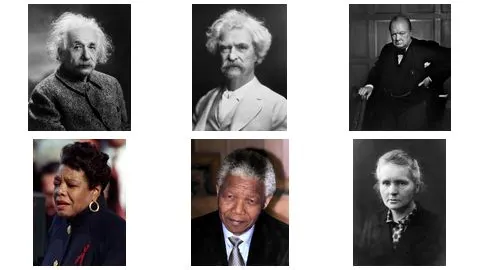
Work out which famous person said it.
Play Guess Who Said ItEverything here is actually attributed
The internet is full of quotations hung on the wrong famous name. The Einstein line about insanity being doing the same thing twice, the Gandhi line about first they ignore you, most of what Marilyn Monroe supposedly said — none of it is here, because a quiz that teaches misattributions would be worse than no quiz.
That constraint changes how the game plays. If a line sounds like something a famous person said in a motivational graphic rather than in a book, a speech or an interview, it is probably not in this deck at all, and the line you are looking at is more likely to be dry, specific and slightly awkward — which is what real quotations sound like.
Reading a line for its speaker
Register is the first cut. A formal periodic sentence with subordinate clauses is a nineteenth-century politician or a novelist. A short declarative with a concrete image is twentieth-century American. Something that sounds like a slogan usually is one, which places it in activism or in technology.
Vocabulary dates a line hard. Words like providence, dominion or virtue place you before 1900. Words like disruption, iteration or leverage place you after 1995 and in exactly one of the six fields.
The four faces are also information. Portraits are pulled from Wikipedia at play time, so you can often date the answer from the photographs alone: three modern press photographs and one nineteenth-century engraving means the engraving is either the obvious answer or the obvious trap, and which of those it is depends on how the line is written.
The clue ladder
Three clues, each costing a rung. The first names their world — science and invention, politics and activism, and so on — which is only useful when the four faces span more than one field, which happens when a small field like art or sport has to be topped up from elsewhere.
The second gives their role in a few words: physicist, civil rights leader, novelist. The third gives their initials, which with four faces in front of you is almost always decisive.
Scoring
Ten rounds, four rungs: 1000, 620, 380, 240. A one-in-four guess costs a rung when it fails, so the arithmetic favours guessing early — a blind pick at the first rung wins 1000 a quarter of the time, and losing it still leaves you at 620 with three faces left.
That is the one game here where a cold guess is defensible strategy rather than impatience.